


Can AI-Generated Content Be Copyrighted in India?
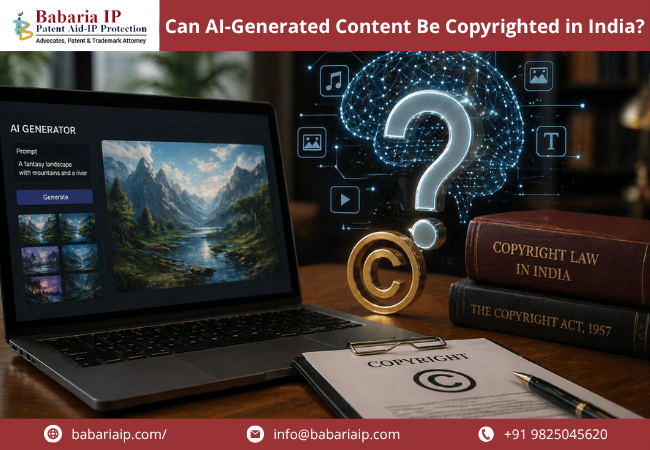
Artificial Intelligence (AI) is changing the way content is created in India. From blog articles and social media captions to logos, images, videos, and even music, AI tools are now being widely used by businesses, startups, creators, and agencies. But one important legal question many people ask is: Can AI-generated content be copyrighted in India?
This is an important topic, especially for businesses that rely on original content for branding and growth. Let’s understand this in simple language.
Understanding Copyright in India
Copyright is a legal right that protects original creative works such as:
- written articles and blogs
- website content
- images and designs
- videos and films
- music and audio
- software code
- artistic works
In India, copyright is governed by the Copyright Act, 1957.
The main purpose of copyright is to give the creator exclusive rights over their work so that no one else can copy, publish, distribute, or use it without permission.
However, the key point here is that copyright protection is generally given to original works created by a human author.
This is where AI creates confusion.
Can AI Content Get Copyright Protection?
The short answer is: it depends on how the content is created.
Under Indian copyright law, the concept of authorship is very important. The law recognises the “author” as the person who creates the work.
For example:
- the writer of an article
- the designer of a logo
- the photographer of an image
- the developer of software
When it comes to AI-generated content, the machine itself cannot be considered a legal author because AI is not a person under Indian law.
This means content created entirely by AI without human creativity or involvement may face difficulty getting copyright protection in India.
What If a Human Uses AI as a Tool?
This is the most common real-world situation.
For example, if you use AI to:
- generate a first draft of a blog
- create image ideas
- suggest logo concepts
- draft ad copy
and then you edit, rewrite, improve, structure, and personalise the content, the final output may qualify for copyright protection because there is meaningful human contribution.
In simple terms, AI can be treated like a tool — just like Photoshop, Canva, or Microsoft Word.
The copyright may belong to the person who used the AI tool creatively and added original human effort.
For Indian businesses, this is the safest practical approach.
Example for Better Understanding
Let’s say a startup in Ahmedabad uses AI to generate website content.
Case 1: Fully AI-generated
The company copies the content exactly as generated by AI and publishes it without any edits.
In this case, copyright ownership may be legally uncertain.
Case 2: Human-edited AI content
The company uses AI for a draft, then rewrites the content in its own tone, adds business details, SEO optimisation, examples, and legal disclaimers.
Here, the final work has human originality and is more likely to be protected.
This is why businesses should avoid publishing raw AI content without human review.
What About AI-Generated Images and Logos?
This is another major concern for Indian businesses.
If AI generates a logo, design, or image, copyright ownership depends on:
- the level of human input
- originality of prompts
- extent of editing
- creative modifications after generation
For example, if you use an AI tool to create a logo and then your designer customises it significantly, the final design may be protected.
This is especially important for trademarks and branding.
Many companies also consult a trademark lawyer india to ensure that their AI-generated logo is not only copyright-safe but also eligible for trademark registration.
Risks of Using AI Content Without Legal Review
Businesses should be careful because AI-generated content can create legal risks such as:
- copyright ownership disputes
- accidental plagiarism
- similarity with existing content
- use of copyrighted training data
- trademark conflicts in brand names or logos
For example, AI may unknowingly generate text or designs that resemble existing protected works.
This can lead to legal notices or infringement claims.
For startups and brands, legal review before publishing is always a smart step.
Current Legal Position in India
As of now, India does not have specific legislation exclusively dealing with AI-generated copyright works.
This area of law is still evolving.
Courts may increasingly look at:
- human creativity involved
- originality
- who controlled the creative process
- who made final decisions
Until clearer laws are introduced, human involvement remains the strongest factor for copyright claims.
Best Practice for Indian Businesses
If your business uses AI tools for content creation, follow these best practices:
- always edit AI-generated content manually
- add your brand tone and insights
- verify originality
- check for plagiarism
- review legal risks for logos and brand assets
- maintain records of prompts and edits
This helps strengthen ownership and reduces legal uncertainty.
Final Thoughts
AI is a powerful tool, but in India, copyright protection still largely depends on human originality and authorship.
If content is created solely by AI, legal protection may be uncertain. But when a person adds meaningful creative effort, the chances of copyright protection become much stronger.
For businesses, startups, creators, and agencies, the safest approach is to use AI as an assistant — not as a replacement for human creativity.
 Categories :
Trademark Attorney
Categories :
Trademark Attorney
 Tags :
AI content legality
, AI content ownership
, AI content risks
, AI copyright India
, AI generated content law
, AI tools legal guide
, copyright rules India
, digital content law India
, intellectual property AI India
, trademark lawyer india
Tags :
AI content legality
, AI content ownership
, AI content risks
, AI copyright India
, AI generated content law
, AI tools legal guide
, copyright rules India
, digital content law India
, intellectual property AI India
, trademark lawyer india
.png)