


Patent vs Trade Secret: Which Should Your Business Choose?
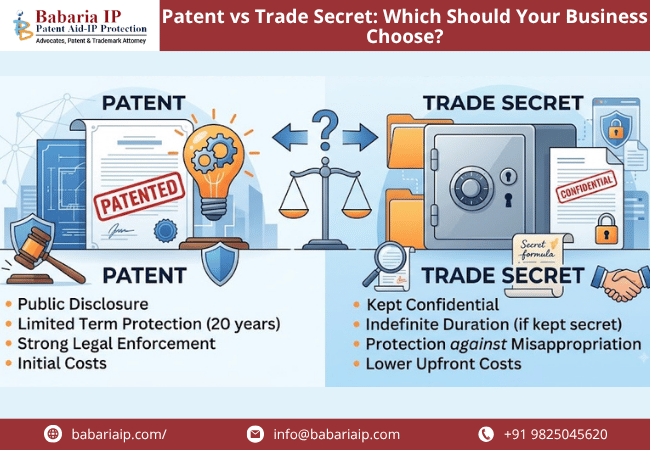
Innovation is one of the biggest assets for any business. Whether you’re a startup developing cutting-edge technology, a manufacturer creating a unique production process, or a pharmaceutical company investing in research, protecting your intellectual property (IP) is essential to maintaining a competitive edge.
When it comes to safeguarding innovations, businesses often face a common question: Should I file a patent or keep my innovation as a trade secret?
While both options offer protection, they serve different purposes and are suitable for different types of innovations. Understanding their differences can help you make the right decision for your business.
What Is a Patent?
A patent is a legal right granted by the government that gives the inventor exclusive rights to make, use, sell, or license an invention for a limited period, generally 20 years from the filing date.
To obtain a patent in India, your invention must be:
- Novel (new)
- Non-obvious (inventive)
- Industrially applicable
Once granted, the patent owner can prevent others from commercially exploiting the invention without permission.
Examples of Patentable Inventions
- Medical devices
- Manufacturing machinery
- Industrial processes
- Software with technical innovation
- Chemical formulations
- Mechanical products
Patents require full disclosure of how the invention works, allowing others to understand it after publication while giving the inventor exclusive commercial rights.
What Is a Trade Secret?
A trade secret is confidential business information that provides a commercial advantage because it is not publicly known.
Unlike patents, trade secrets are not registered with any government authority. Protection exists as long as the information remains confidential.
Examples include:
- Secret manufacturing processes
- Customer databases
- Business strategies
- Pricing models
- Product formulas
- Proprietary algorithms
One of the world’s most famous trade secrets is the formula for Coca-Cola, which has remained confidential for over a century.
Patent vs Trade Secret: Key Differences
| Feature | Patent | Trade Secret |
| Registration | Required | Not required |
| Government Protection | Yes | No |
| Duration | 20 Years | Unlimited (while secret) |
| Public Disclosure | Mandatory | No disclosure |
| Cost | Filing and maintenance fees | Lower initial cost |
| Legal Enforcement | Strong statutory rights | Depends on confidentiality measures |
| Risk | Competitors learn your invention after publication | Risk if secrecy is lost |
Advantages of Patents
Exclusive Rights
A patent gives you the legal authority to stop competitors from manufacturing, selling, or importing your invention.
Higher Business Value
Patents increase the valuation of startups and established businesses. Investors often consider patented technology a valuable asset.
Licensing Opportunities
Patent owners can generate additional revenue by licensing their inventions to other businesses.
Easier Legal Enforcement
Patent infringement cases are generally easier to pursue because ownership is officially recognised by law.
Advantages of Trade Secrets
Unlimited Protection
Unlike patents that expire after 20 years, trade secrets remain protected indefinitely if confidentiality is maintained.
No Registration Costs
Businesses do not have to pay filing fees, renewal fees, or undergo lengthy examination procedures.
Immediate Protection
Protection begins as soon as the information is treated as confidential.
No Disclosure
Competitors cannot access technical details because nothing is published.
When Should You Choose a Patent?
A patent is usually the better option if:
- Your invention can be reverse-engineered after launch.
- You plan to manufacture products at scale.
- Investors require strong IP protection.
- You intend to license your technology.
- Competitors could easily copy your innovation.
For example, a company designing an innovative medical device should consider patent protection because competitors can study and replicate the product once it reaches the market.
When Should You Choose a Trade Secret?
A trade secret may be the better choice if:
- The innovation cannot be easily reverse-engineered.
- The information is used internally.
- Long-term secrecy is practical.
- You want protection beyond 20 years.
Examples include:
- Manufacturing recipes
- Supplier pricing strategies
- Internal business processes
- Proprietary software algorithms
- Quality control methods
Many food manufacturers rely on trade secrets instead of patents because recipes are difficult for competitors to replicate exactly.
Can Businesses Use Both?
Yes. In many cases, businesses combine both strategies.
For example:
A manufacturing company may:
- Patent its innovative machine design.
- Keep the production process confidential as a trade secret.
- Protect customer databases through confidentiality agreements.
- Register trademarks for its brand.
Using multiple forms of intellectual property protection creates a stronger competitive advantage.
Factors to Consider Before Choosing
Before deciding, ask yourself the following questions:
Can competitors easily copy my invention?
If yes, a patent may provide stronger protection.
Can I realistically keep it confidential?
If maintaining secrecy is difficult, relying solely on a trade secret may be risky.
How long do I need protection?
Patents offer fixed-term protection, while trade secrets can potentially last forever.
What is my business strategy?
If licensing or attracting investors is a priority, patents often provide greater commercial value.
What is my budget?
Patent filing involves professional fees and government charges, while trade secrets primarily require strong internal confidentiality measures.
Common Mistakes Businesses Make
Many businesses unintentionally weaken their intellectual property by:
- Publicly disclosing inventions before filing a patent.
- Failing to use Non-Disclosure Agreements (NDAs).
- Assuming all innovations should be patented.
- Neglecting employee confidentiality policies.
- Delaying IP protection until competitors enter the market.
Taking early action can prevent costly disputes and protect years of research and development.
Final Thoughts
There is no one-size-fits-all answer when choosing between a patent and a trade secret. The right option depends on the nature of your innovation, your business goals, industry, and long-term growth strategy.
If your invention can be easily copied or has strong commercial potential, patent protection is often the preferred route. On the other hand, if your competitive advantage relies on confidential processes or proprietary know-how that can remain secret, a trade secret may provide lasting value.
Many successful businesses combine both approaches to build a comprehensive intellectual property strategy that safeguards innovation while supporting future growth. If you’re considering patent services india, consulting experienced IP professionals can help you evaluate your innovation and choose the most effective protection strategy for your business.
 Categories :
Patent
Categories :
Patent
 Tags :
Business IP Strategy
, Innovation Protection
, Intellectual Property
, Intellectual Property Rights
, IP Protection
, patent attorney india
, patent law India
, patent protection
, patent services India
, Patent vs Trade Secret
, Trade Secret Protection
, Trade Secrets India
Tags :
Business IP Strategy
, Innovation Protection
, Intellectual Property
, Intellectual Property Rights
, IP Protection
, patent attorney india
, patent law India
, patent protection
, patent services India
, Patent vs Trade Secret
, Trade Secret Protection
, Trade Secrets India
.png)